
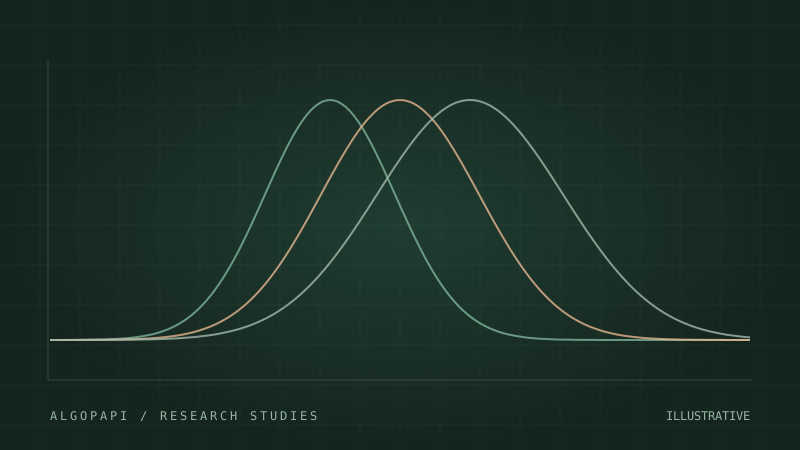
Illustrative mathematical surface · Research note
Comparing implied probabilities across related contracts to understand consistency, friction, and mispricing. This illustrative research note sets out an approach, its assumptions, and the questions left open.
Research
repositories
Get the notebooks, modeling code, and supporting datasets behind the videos as they become available.
- Full research archive
- New published projects
- Reproducible experiments
Membership opens when the first repository files are ready. No payments are being collected.
Recurring monthly subscription · Cancel anytimeTwo prices, one question
Related prediction contracts can appear to disagree. Before treating a difference as a signal, compare their resolution criteria, time horizons, fees, and executable prices. Similar titles do not guarantee identical payoffs.
Methodology
Construct a table of mutually exclusive, collectively exhaustive outcomes. Record bid and ask prices at the same timestamp. Use the executable side of each quote, rather than adding midpoints and calling the result an opportunity.
This identity describes a coherent probability model for exhaustive outcomes. Market quotes can deviate without offering an executable profit.
A synthetic experiment
quotes = [0.46, 0.34, 0.24]
friction = 0.02 * len(quotes)
excess = sum(quotes) - 1
print(excess, friction)
These values are illustrative. Their sum exceeds one, but the observation says nothing about an achievable return without side-specific prices and transaction assumptions.
Findings to test
Separate structural inconsistencies from stale observations. Evaluate the same rule across a held-out set of contracts. Include unsuccessful orders and partial fills in any later execution study.
Limitations
No live data or measured performance is presented here. Resolution ambiguity and capital lockup may dominate a small apparent price difference. This note is a research starting point, not an execution recommendation.