
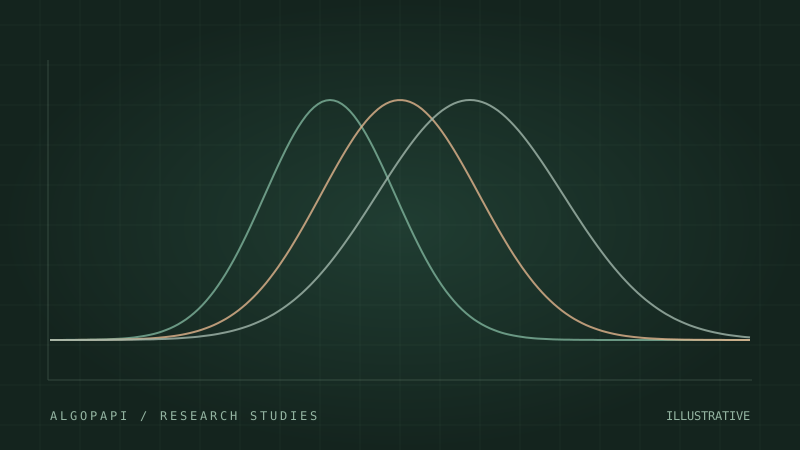
Illustrative mathematical surface · Research note
Bayesian updating as a language for changing your mind, with an emphasis on uncertainty that remains. This illustrative research note sets out an approach, its assumptions, and the questions left open.
Research
repositories
Get the notebooks, modeling code, and supporting datasets behind the videos as they become available.
- Full research archive
- New published projects
- Reproducible experiments
Membership opens when the first repository files are ready. No payments are being collected.
Recurring monthly subscription · Cancel anytimeMake assumptions visible
A prior expresses what a model assumes before new evidence arrives. Choosing one does not remove subjectivity; it makes a part of that subjectivity explicit and testable.
A small conjugate example
For binary observations, a beta prior and binomial likelihood give a convenient posterior:
Here s is the number of successes in n observations. The model assumes exchangeable observations; that assumption often needs scrutiny in financial data.
alpha, beta = 2, 2
successes, total = 7, 10
posterior_mean = (alpha + successes) / (alpha + beta + total)
Methodology
Compare weak, skeptical, and optimistic priors. Plot their prior predictive distributions before fitting. Then examine whether the posterior is stable across those choices and whether predictions are calibrated on new observations.
What changes with evidence
More observations can reduce uncertainty, but repeated correlated observations carry less information than independent ones. A posterior interval is conditional on the model, including its assumptions.
Limitations
The example is synthetic and educational. A beta-binomial model does not capture time-varying probabilities, market feedback, or regime changes.